Optimizing Direct Store Delivery: Automation Best Practices for Dynamics 365 Users
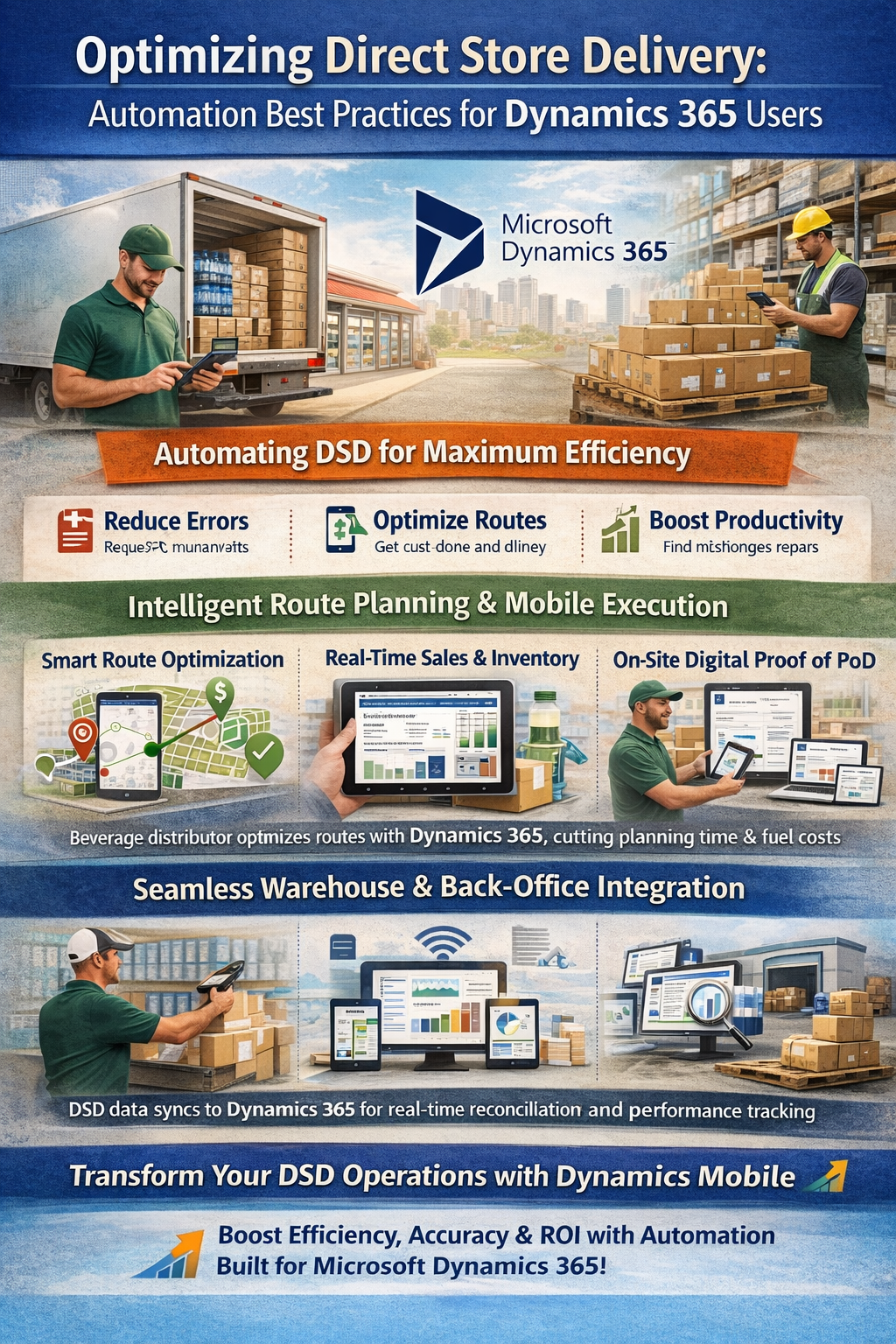
In the fast-paced world of distribution, the difference between thriving and merely surviving often comes down to operational efficiency. For businesses relying on Direct Store Delivery (DSD), manual processes, inventory inaccuracies, and inefficient route planning are not just minor headaches – they're significant drains on profitability and customer satisfaction. The good news? Strategic automation, particularly when integrated with a robust ERP like Microsoft Dynamics 365, offers a clear path to overcoming these challenges and transforming your DSD operations.
The Imperative of DSD Automation for Modern Distributors
Direct Store Delivery (DSD) is more than just logistics; it's a critical competitive differentiator, allowing distributors to maintain closer relationships with retailers, control shelf presence, and respond rapidly to market demands. However, traditional DSD models are frequently plagued by:
- Manual Errors: From order taking to invoice generation and inventory reconciliation, human error can lead to costly mistakes, chargebacks, and lost sales.
- Inventory Discrepancies: Inaccurate stock counts on trucks or at customer locations result in missed sales opportunities or excessive returns.
- Inefficient Route Planning: Suboptimal routes waste fuel, time, and driver capacity, directly impacting the bottom line and delivery timelines.
- Delayed Reconciliation: End-of-day processes involving stacks of paperwork delay cash flow and obscure real-time performance.
Strategic automation transforms DSD from a potential cost center into a driver of efficiency, accuracy, and customer satisfaction. By streamlining workflows and digitizing critical touchpoints, distributors can reduce operational costs, improve service levels, and gain a competitive edge.
Strategic Planning & Data Integration with Dynamics 365
The foundation of effective DSD automation lies in a centralized, intelligent data hub. Microsoft Dynamics 365 Business Central or Finance & Operations serves as this crucial backbone, unifying all DSD-related data:
- Customer Profiles: Detailed purchasing history, delivery preferences, and credit terms.
- Pricing & Promotions: Real-time access to current offers and special deals.
- Real-time Inventory: Accurate stock levels across warehouses and on trucks.
- Order Management: Centralized processing of pre-orders, standing orders, and dynamic adjustments.
Leveraging this integrated data, distributors can implement automated order processing and intelligent route optimization tools. These systems pull data directly from Dynamics 365 to create efficient, profitable delivery schedules, taking into account factors like delivery windows, truck capacity, traffic patterns, and customer priority.
Practical Example: A large beverage distributor uses Dynamics 365 to automatically generate daily DSD routes. Based on customer order history, specific delivery windows, and the varying capacities of their truck fleet, the system calculates the most efficient sequence of stops. These optimized routes, complete with turn-by-turn navigation and delivery instructions, are then pushed directly to the field devices of their drivers before dispatch each morning, significantly reducing planning time and fuel consumption.
Optimizing On-Route Execution & Customer Service Excellence
Once routes are planned, empowering field teams with the right tools is paramount. Mobile solutions, deeply integrated with Dynamics 365, provide drivers and sales reps with real-time access to essential information and functionalities directly on their Android or iOS devices.
- Real-time Information: Access to customer details, product catalogs, pricing, and on-truck inventory levels, ensuring informed interactions.
- Dynamic Order Adjustments: The ability to modify orders, add impulse purchases, or process returns on the fly.
- Streamlined Proof of Delivery (PoD): Digital signature capture, photo verification for delivered goods or shelf placement, and timestamping.
- Secure Mobile Payment: On-site processing of credit card, cash, or check payments, instantly updating customer accounts.
Practical Example: A food distributor's driver arrives at a grocery store. Using a mobile application (such as Dynamics Mobile), they quickly scan delivered items, capture the store manager's digital signature for proof of delivery, and then process a credit card payment on the spot. During the interaction, the manager points out a damaged item from a previous delivery; the driver immediately records the return, captures a photo of the damage, and initiates the credit process – all actions that update Dynamics 365 in real-time or near real-time, ensuring accurate billing and inventory adjustments.
Streamlining Warehouse & Loading Bay Operations for DSD
The efficiency of DSD extends beyond the road to the warehouse. Seamless integration between DSD route plans and warehouse operations is crucial for accurate and timely order fulfillment.
- Automated Picking Lists: DSD routes generated in Dynamics 365 automatically trigger optimized picking lists for warehouse staff, organized by route and stop sequence.
- Mobile Scanning for Accuracy: Utilizing mobile scanners for efficient picking and packing minimizes errors and ensures the right products are staged for the correct route.
- Automated Loading Verification: Before dispatch, trucks can be scanned to verify that every item on the manifest has been loaded, preventing discrepancies and costly return trips.
Practical Example: Warehouse staff receive picking lists generated directly from the day's DSD routes in Dynamics 365. They use mobile scanners to pick items, which are then automatically staged by route in designated loading areas. As each truck is loaded, a final scan verifies the contents against the digital manifest, ensuring every truck leaves the bay with precisely the correct products for its assigned route, dramatically reducing loading errors and dispatch delays.
Post-Delivery Reconciliation & Performance Analytics
The culmination of an automated DSD process is streamlined back-office operations and actionable insights. Automation eliminates manual paperwork, reduces administrative overhead, and provides immediate visibility into performance.
- Automated Reconciliation: End-of-day sales, returns, and payment data are automatically synced from field devices to Dynamics 365. This automates the reconciliation of cash, inventory, and accounts receivable.
- Comprehensive Reporting & Dashboards: Dynamics 365 can generate rich reports and dashboards, offering deep analysis of DSD performance metrics. This includes delivery success rates, route profitability, sales trends by product or customer, and driver efficiency.
- Proactive Issue Resolution: Real-time data allows managers to identify and address issues promptly, from delivery exceptions to payment discrepancies.
Practical Example: At the end of a shift, a driver's mobile device automatically syncs all sales, payment, and return data collected throughout the day back to Dynamics 365. The system then automatically reconciles cash collected against sales, updates inventory levels, and posts transactions to the general ledger. This provides the finance team with instant, accurate visibility into daily DSD operations, profitability, and outstanding balances, eliminating hours of manual data entry and reconciliation.
Selecting the Right Technology Partner for Dynamics 365 DSD Automation
Implementing DSD automation is a strategic investment. Choosing the right technology partner is crucial for success:
- Deep, Native Integration: Prioritize solutions that offer deep, native integration with Microsoft Dynamics 365 Business Central or Finance & Operations. This ensures seamless data flow, reduces the need for custom development, and provides a unified operational view across your entire business.
- Robust, Scalable Mobile Platforms: Look for solutions built specifically for the complexities of direct store delivery, supporting both Android and iOS devices. The platform should be robust enough to handle offline capabilities, diverse workflows, and a large volume of transactions.
- Comprehensive Support & Roadmap: Partner with a vendor that offers excellent support, continuous updates, and a clear roadmap for future enhancements. Your DSD automation strategy should be able to evolve with your business needs and market changes.
By focusing on these best practices, distributors can harness the power of automation to transform their DSD operations from a logistical challenge into a strategic advantage. The integration of specialized mobile solutions with Microsoft Dynamics 365 creates a powerful ecosystem that drives efficiency, accuracy, and ultimately, profitability.
Explore how a dedicated DSD automation solution built on Microsoft Dynamics 365, like Dynamics Mobile, can transform your distribution operations and drive measurable ROI.