Why Offline-First is Non-Negotiable for Enterprise Mobile
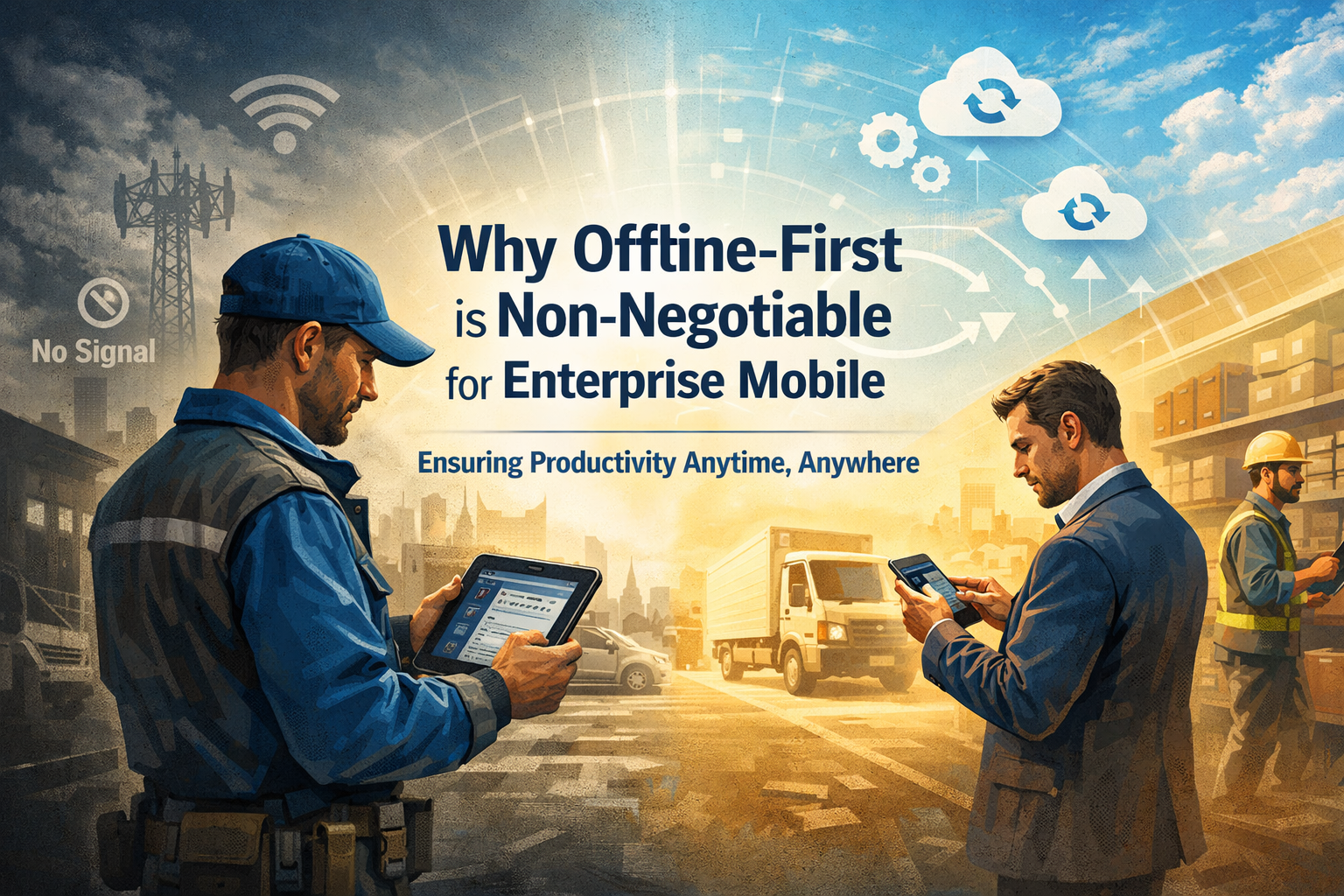
Imagine a field service technician unable to access critical schematics mid-repair, a DSD driver stalled at a delivery point because their device can’t process an invoice, or a sales rep losing a potential order because the CRM won't load. These aren't hypothetical scenarios; they are daily frustrations for mobile workforces reliant on constant connectivity. In an enterprise environment where every minute counts, such interruptions don't just cause minor annoyances—they lead to significant financial losses, operational inefficiencies, and a deteriorating customer experience. The solution isn't better network coverage everywhere, but a strategic shift to an offline-first mobile approach.
Understanding the True Meaning of Offline-First
The term 'offline-first' is often misunderstood, frequently conflated with a basic 'offline mode.' However, the distinction is crucial for enterprise operations.
Defining Offline-First vs. Basic Offline Mode
Offline-first isn't merely about having some limited functionality when a connection drops. It's a foundational design philosophy where the application is built to function fully and optimally without any network connection, making the 'online' state a progressive enhancement. This means proactively managing data, storing relevant information locally, and designing the user experience (UX) to be seamless regardless of network status. When connectivity is available, it's used for synchronization, not as a prerequisite for core functionality.
Why Traditional 'Offline Mode' Falls Short for Complex Enterprise Tasks
Traditional 'offline modes' often provide only a stripped-down version of an application, allowing users to view cached data but severely limiting their ability to perform actions like creating new records, submitting forms, or executing complex workflows. For a field sales representative needing to configure a custom order, check real-time inventory, and process a payment, or a warehouse operative managing intricate picking lists, such limitations render the application largely useless when connectivity is lost.
The Foundational Principle: Data Availability and Functionality Regardless of Network Status
At its core, offline-first ensures that all necessary data—customer profiles, product catalogs, service histories, work orders, pricing, inventory levels, route plans—is always available to the user. More importantly, the application's full suite of features remains functional, enabling continuous data capture, task execution, and decision-making, even in the most remote or signal-deprived locations.
The Unpredictable Reality of Enterprise Field Operations
The modern enterprise workforce operates in diverse and often challenging environments where reliable connectivity is far from guaranteed.
Addressing Common Connectivity Challenges
Mobile professionals constantly encounter:
Remote Sites: Agricultural areas, construction zones, or rural service locations.
Dead Zones: Basements, elevators, thick-walled buildings, or areas with poor cellular coverage.
Unreliable Wi-Fi: Public hotspots, client networks with strict firewalls, or intermittent signals.
Transit: During commutes, in tunnels, or on long-haul routes where signal strength fluctuates.
The High Cost of Downtime: Lost Productivity, Delayed Service, Missed Sales Opportunities
Each moment of connectivity loss translates directly to business costs. A field service technician unable to update a work order means delayed billing and potentially missed service level agreements (SLAs). A DSD driver unable to record a delivery means inventory discrepancies and payment delays. A sales rep unable to process an order means lost revenue and a frustrated customer.
Impact on Various Roles
Field Sales: Inability to access product catalogs, customer history, or process orders on the spot.
DSD/Route Accounting: Cannot record deliveries, manage on-truck inventory, capture signatures, or process payments.
Field Service: Unable to retrieve work order details, access repair manuals, order parts, or update job status.
Warehouse Management: Disrupts real-time picking, packing, receiving, and inventory updates, leading to bottlenecks.
Fleet Control: Drivers cannot access optimized routes, log activities, or provide real-time proof of delivery.
Ensuring Uninterrupted Productivity and Data Integrity
An offline-first strategy is the bedrock of continuous operations and reliable data management.
Empowering Continuous Work: Data Capture, Task Execution, and Access to Critical Information Offline
With an offline-first solution, a field sales rep can still create detailed quotes, a DSD driver can complete an entire route of deliveries with signature capture, and a service technician can execute complex diagnostics—all without a live connection. All necessary forms, data fields, and business logic are available locally on the device.
Seamless Data Synchronization: Intelligent, Automatic Updates When Connectivity is Restored
The magic of offline-first lies in its intelligent synchronization. Once a connection is re-established, the application automatically and seamlessly uploads all captured data and downloads any updates, ensuring that the central system (like Microsoft Dynamics 365) remains current. This often involves delta synchronization, sending only changes, which is efficient even on intermittent connections.
Minimizing Errors and Data Loss: Robust Mechanisms for Conflict Resolution and Data Consistency
Advanced offline-first platforms incorporate sophisticated conflict resolution strategies. If two users modify the same record, the system can be configured to apply the 'last-write-wins' rule, prompt the user for resolution, or merge changes intelligently, thereby preventing data inconsistencies and loss. This ensures that the integrity of your enterprise data is maintained even under challenging conditions.
Enhancing User Experience and Workforce Adoption
Beyond functionality, offline-first significantly impacts the end-user experience, which is critical for adoption.
Reducing User Frustration: Eliminating Waiting Times and Connectivity-Related Roadblocks
Nothing frustrates a mobile worker more than a spinning wheel or an error message due to a lost connection. Offline-first eliminates these productivity killers, allowing users to work at their own pace without interruption. This fosters a sense of reliability and efficiency.
Intuitive Workflows: Designing Applications That Perform Consistently, Online or Offline
An offline-first application is designed from the ground up to offer a consistent, high-performance experience. The user doesn't need to think about whether they are online or offline; the application simply works, adapting intelligently to the network state in the background.
Boosting Adoption Rates: A Reliable, High-Performing App Encourages Consistent Usage
When an application is reliable, fast, and consistently functional, users are far more likely to embrace it fully and integrate it into their daily routines. Conversely, an unreliable app, constantly hampered by connectivity issues, will quickly be circumvented or abandoned, undermining your investment in mobile technology.
Strategic Business Advantages and ROI
The benefits of an offline-first strategy extend far beyond mere convenience, delivering tangible ROI across the enterprise.
Improved Operational Efficiency: Faster Task Completion and Reduced Administrative Overhead
By eliminating connectivity delays, mobile workers complete tasks faster, process more transactions, and spend less time on administrative catch-up. This directly translates to higher productivity per employee and lower operational costs.
Enhanced Customer Satisfaction: Reliable Service Delivery and Real-Time Information Access
Customers benefit from faster, more reliable service. A sales rep can provide immediate answers and process orders on the spot. A service technician can complete repairs without delays. A DSD driver can ensure accurate deliveries and instant proof of service, all contributing to a superior customer experience.
Compliance and Audit Readiness: Maintaining Accurate Records Even in Challenging Environments
For industries with strict regulatory requirements, maintaining complete and accurate records is non-negotiable. Offline-first ensures that all data capture, from signatures to timestamps, is recorded reliably, providing a comprehensive audit trail regardless of network availability.
Scalability and Future-Proofing: Building a Resilient Mobile Infrastructure
An offline-first architecture provides a robust, resilient foundation for your mobile strategy. It ensures that your operations can scale and adapt to new challenges, geographies, and technologies without being constrained by network limitations.
"In the digital age, true mobility isn't about being connected everywhere; it's about being productive everywhere."
Key Considerations for Implementing an Offline-First Strategy
While the benefits are clear, successful implementation requires careful consideration of several technical aspects.
Robust Data Synchronization Logic: Handling Complex Data Models and Business Rules
The platform must be capable of handling intricate data relationships, custom business rules, and various data types, ensuring that synchronization is not just fast but also accurate and compliant with your enterprise logic.
Security and Data Encryption: Protecting Sensitive Information on Disconnected Devices
When data is stored locally on devices, robust security measures are paramount. This includes strong encryption for data at rest and in transit, secure authentication, and remote wipe capabilities to protect sensitive enterprise and customer information.
Device Storage and Performance Optimization: Managing Data Footprint Effectively
An effective offline-first solution must intelligently manage the volume of data stored on devices, optimizing for performance without consuming excessive storage. This involves smart caching, data compression, and selective synchronization.
Choosing the Right Platform: Capabilities for Seamless Integration with Core ERP Systems like Dynamics 365
Crucially, an offline-first mobile solution must integrate seamlessly with your core enterprise resource planning (ERP) system. A platform built specifically for Microsoft Dynamics 365 / Business Central, like Dynamics Mobile, offers inherent advantages, ensuring data consistency, streamlined workflows, and a unified view of your operations.
The modern enterprise cannot afford to be tethered to unreliable network connections. Adopting an offline-first mobile strategy isn't just a technical enhancement; it's a strategic imperative that drives productivity, enhances customer satisfaction, and builds a resilient, future-proof operational framework. Ready to empower your mobile workforce with truly uninterrupted operations? Explore how Dynamics Mobile, built on Microsoft Dynamics 365, delivers robust offline-first capabilities for your enterprise.