Why Warehouses Are Choosing Boring Robots Over Humanoids
The News
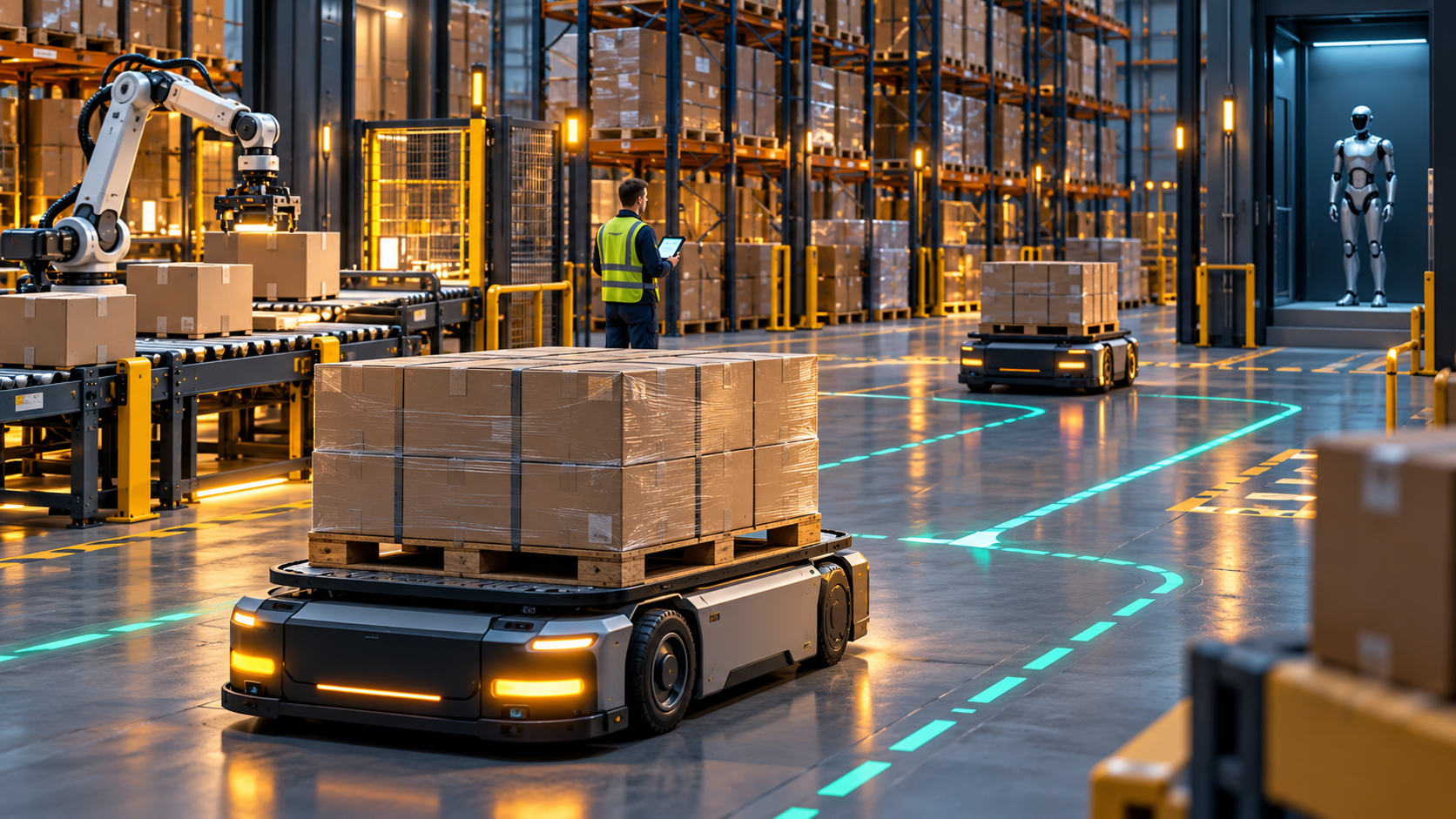
Three warehouse automation announcements in September 2026 point in the same direction, and none of them involved a humanoid.
Hai Robotics announced on September 8 that it will deploy more than 1,500 HaiPick Climb rack-climbing robots for a leading European fashion retailer, inside a single 30,000 m² automated fulfillment center. The system targets throughput exceeding 24,000 totes per hour and holds roughly 1.2 million double-deep storage locations. Hai calls it the world’s largest rack-climbing warehouse robot deployment.
Vecna Robotics closed a $31 million funding round on September 10, led by Unless with participation from Drive Capital, Tiger Global, Highland Capital Partners, and Tectonic Ventures. Vecna says demand for its CaseFlow case-picking system has more than doubled year over year since its 2025 launch, and that a GEODIS deployment doubled picking throughput while cutting training time.
CEVA Logistics launched a pilot on September 10 using two Zelostech Z10 autonomous electric vehicles at its Blue Hub facility in Singapore — an eight-storey, 50,000 m² site. The vehicles move pallets and totes between floors over the building’s existing ramps, replacing diesel truck movements, with expected annual CO₂ savings of at least 4,600 kg.
Wheeled, purpose-built, and unglamorous. That is the pattern worth noticing.
Why It Matters
Humanoid robotics gets the keynote slots. Warehouses get the reliability math. And the reliability math is brutal in a way that a stage demo never has to be.
Liu Lige, who leads warehousing embodied robots at JD Logistics, put the standard plainly: a scenario suitable for large-scale deployment needs high frequency, high standardization, high quantifiability, and a low cost of failure — and the core technical metric is the task completion rate, not the success rate of a single grab. A 95% single-grasp success rate looks impressive in a launch video. Across tens of thousands of daily operations, it means thousands of human interventions a day. JD Logistics says large-scale deployment requires four nines — a 99.99% end-to-end task completion rate — plus the ability to recover autonomously when something goes wrong.
That is the whole argument in two sentences. Reliability at scale is not a feature of the robot. It is a property of the system around the robot: the orchestration, the exception handling, and the software layer that knows what to do when a task fails at 02:00 with nobody watching.
The Details
Hai Robotics: density and throughput, not novelty
The HaiPick Climb configuration is a rack-climbing autonomous case-handling system. The bet is not that a robot can do something a human cannot — it is that 1,500 of them, coordinated in one integrated system, can absorb peak-season order surges that would otherwise require a multi-year conventional build-out. Hai says HaiPick Climb has now passed 10,000 robots deployed across global customer projects. Scale is the product.
Vecna Robotics: the human stays, the walking goes
CaseFlow combines autonomous pallet-handling robots with orchestration software that coordinates robots and people in real time. In the GEODIS deployment, robots traverse the pick path while teammates load goods, eliminating the non-value-added travel and the get-on-get-off cycle of a manual pallet jack. Steve Elsbury, Senior Operations Manager at GEODIS, noted that new pickers working alongside the robots typically start at a performance level of 200% compared with the previous manual setup — a number that matters more than any throughput headline, because it means the system is not dependent on recruiting experienced pickers.
CEVA Logistics: the boring task nobody wants to automate
The Zelostech Z10 pilot is not a picking robot. It moves pallets, totes, and inventory between floors of an eight-storey hub using the building’s existing ramps — work previously done by diesel trucks. No dedicated lift, no fixed guideway, no new infrastructure. It is the least exciting robot in this article and arguably the most telling: it targets a repetitive, low-skill, high-frequency internal transfer where the cost case is straightforward.
The Reliability Math: 95% Is Not a Grade, It Is a Queue
Every warehouse leader evaluating automation should run this calculation before a pilot, not after:
Metric | What it sounds like | What it means at 30,000 tasks/day |
|---|---|---|
95% single-task success | “Very accurate” | ~1,500 exceptions a day needing a human |
99.9% task completion | “Very good” | ~30 exceptions a day |
99.99% task completion | “Boring, finally” | ~3 exceptions a day |
The gap between 95% and 99.99% is not a 5% improvement. It is the difference between a system that creates work and a system that removes it. That is why purpose-built wheeled robots keep winning deployments: their failure modes are bounded, their recovery is scriptable, and their software has been engineered for the exception rather than the demonstration.
Humanoids will matter. When they do, it will be because the same discipline has been applied to them — bounded tasks, known failure modes, autonomous recovery, and an orchestration layer that absorbs the bad day.
What This Means for Your Warehouse
Ask for end-to-end completion rates, not grab success rates. Any vendor metric that stops at the individual action is a demo metric.
Ask what happens on failure. Autonomous recovery is the requirement. Manual intervention at scale is the hidden cost that never appears in the business case.
Automate the repetitive transfer before the clever task. CEVA’s floor-to-floor moves are a better first project than anything that needs a gripper to make a judgement.
Budget for the software layer. Robots do not reconcile inventory, post transactions to the ERP, or escalate a variance to a supervisor. Something has to.
Where Mobile Execution Fits
This is the same argument Dynamics Mobile has been making about AI in field operations, applied to the warehouse: reliable execution beats impressive demonstration.
The warehouse is already full of automated decisions — goods-to-person systems, AGVs, and now rack-climbing fleets. What remains stubbornly manual is the reconciliation around them: does the physical count match the mobile record, does the mobile record match the ERP, and does anyone find out before the discrepancy becomes a write-off. Published platform benchmarks put the average time to detect a field data anomaly at 4–7 days and the share of ERP reconciliation still done by hand at 73%. Those are the numbers agents should be attacking, and they are the numbers nobody demos at a keynote.
Dynamics Mobile’s warehouse mobility runs jobs directly from Microsoft Dynamics 365 Business Central: barcode and QR scanning at every step for items, bins, and lot or batch tracking, quantity validation and expiry checks on-device, and every pick, receive, put-away, transfer, or count posted to Business Central in real time. On top of that data stream, background agents in early access run daily reconciliation between physical counts, mobile records, and ERP inventory, detect pick-accuracy patterns per worker, shift, and zone, and raise expiry and batch anomalies before they become write-offs.
One honest constraint, because it changes how you scope a project: Warehouse Mobility requires a live network connection. It is designed to be online, and it is the right tool when your facility has the coverage to support it — the offline-first design belongs to the field applications, where connectivity genuinely disappears.
The pattern that is winning in warehouses — purpose-built, bounded, boring, relentlessly reliable — is the pattern to look for in software too. A platform that posts to your ERP on every scan and reconciles every night is doing more for your throughput than any agent that only ever performs well on the best day.
Warehouse Mobility for Dynamics 365 Business Central
Real-time picking, receiving, put-away, transfers, and stock counts on rugged mobile devices — barcode-verified at every step, posted to Business Central as it happens, with agent-based reconciliation and anomaly detection in early access.