What Is Fleet Management Software and Why Should It Live in Your ERP?
A fleet management system tracks, dispatches, and optimises a company's vehicles — from route planning and driver assignment to maintenance scheduling and fuel monitoring. Traditional fleet management software runs as a standalone platform, entirely separate from the ERP that handles orders, inventory, and invoicing.
The result: two systems that are always slightly out of sync. Orders are in the ERP. Vehicles are in the TMS. Someone has to export, import, or manually transfer data between them at every stage of the delivery cycle.
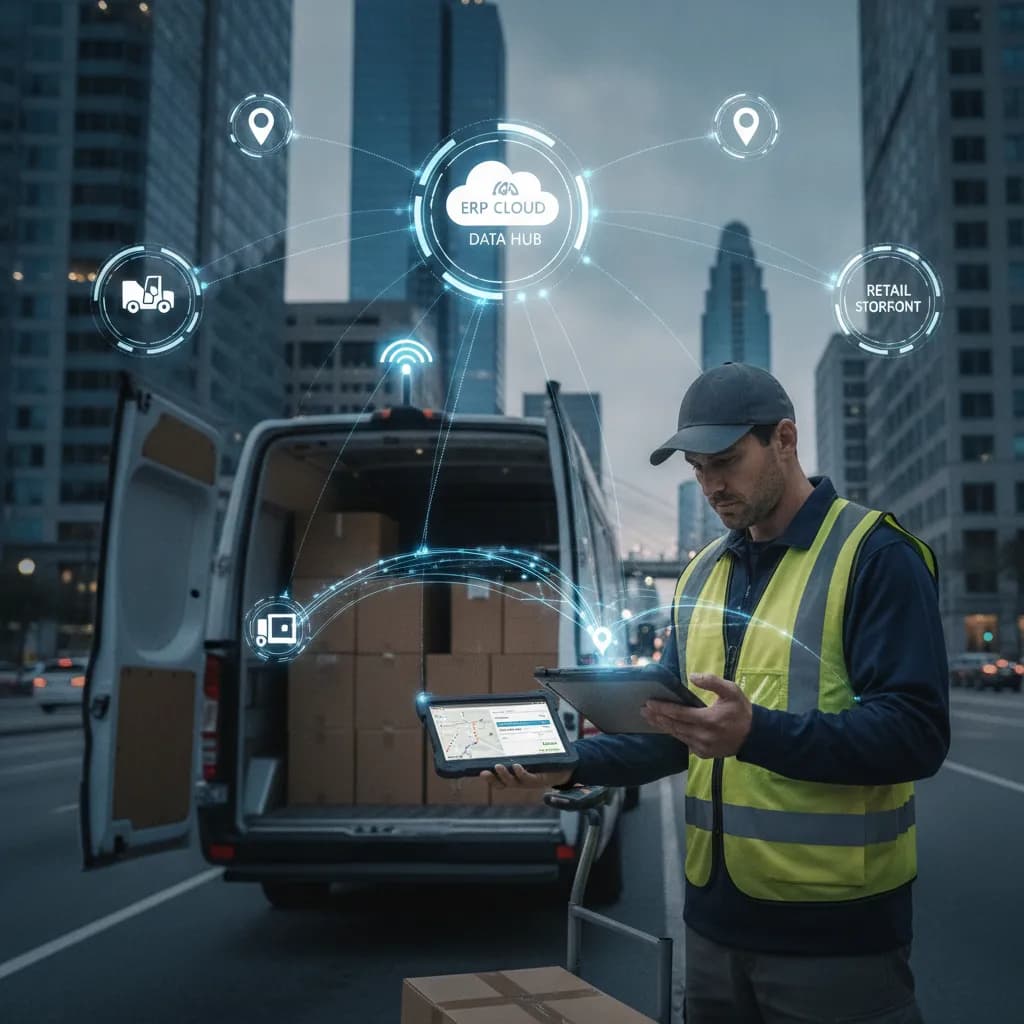
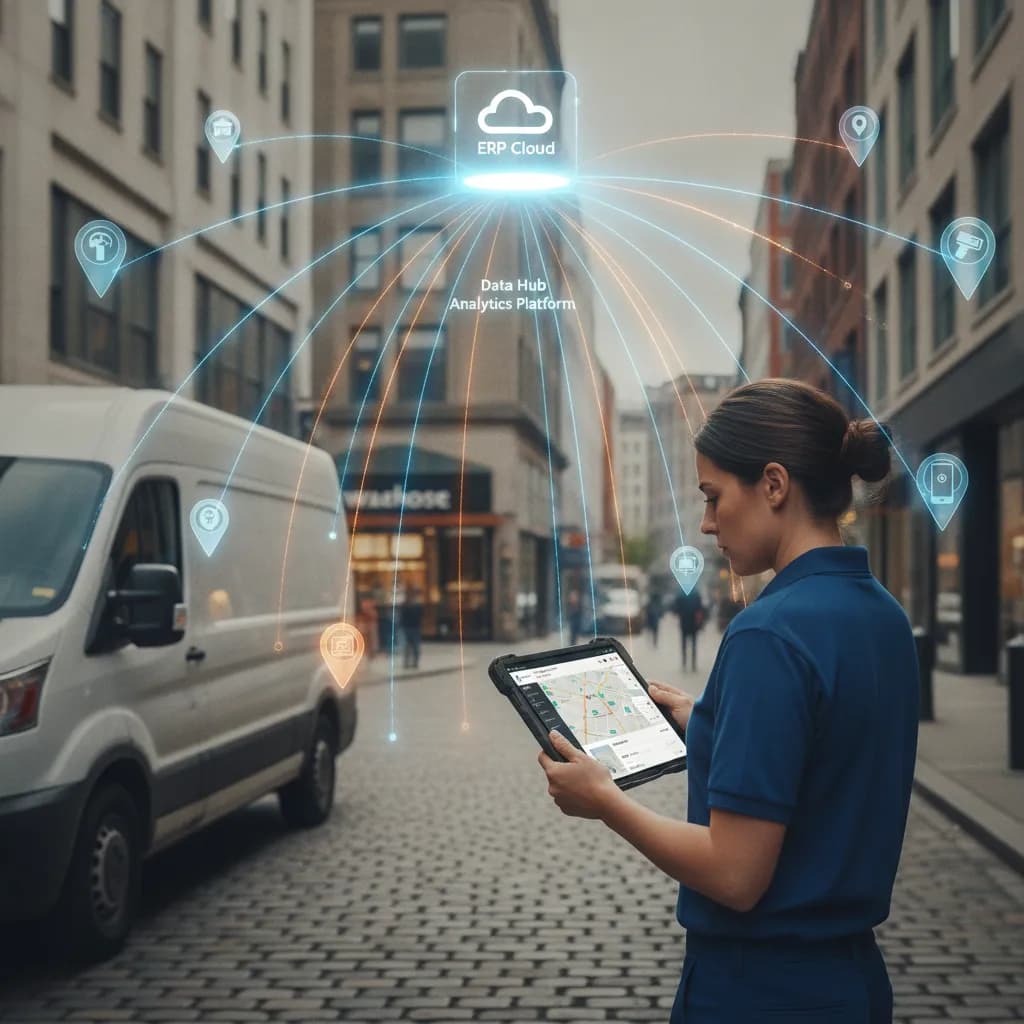
Dynamics Mobile Fleet Control solves this by embedding fleet management directly inside Microsoft Dynamics 365 Business Central. Orders flow automatically into route plans. Drivers execute on mobile. Proof of delivery syncs back to BC. Fleet maintenance costs post to the correct cost centres. Everything in one system.
Fleet Management Capabilities in Business Central
Fleet dispatch software: Assign orders to vehicles and drivers from a live dispatch board inside Business Central. See vehicle locations, available capacity, and open jobs in real time.
Route optimisation: Automatically calculate multi-stop delivery routes by distance, time windows, and vehicle load capacity. Drag-and-drop adjustments for same-day changes.
Vehicle tracking and fleet management: GPS tracking gives dispatchers live visibility of every vehicle's position, speed, and stop history. Geofence alerts for arrivals and departures.
Truck fleet management: Manage HGVs, LGVs, and mixed fleets with vehicle-specific capacity, compliance, and maintenance profiles. Tachograph compliance tracking built in.
Mobile driver app: Drivers receive route instructions, delivery details, and navigation on a mobile app. Electronic proof of delivery (signature, photo, barcode scan) captured on the spot.
Fleet maintenance scheduling: Link vehicle service schedules to Dynamics Mobile's maintenance engine. BC generates work orders automatically at service intervals — no separate fleet maintenance system needed.
Fuel and cost tracking: Log fuel consumption against vehicles. All fleet costs — maintenance, fuel, driver labour — post to BC dimensions for accurate cost-per-vehicle reporting.
Fleet Control vs. Standalone Fleet Management Companies / TMS
Capability | Dynamics Mobile Fleet Control (BC-native) | Standalone TMS / Fleet Platform |
|---|
ERP order sync | ✅ Automatic, real-time | ⚠️ API/CSV integration needed |
Route optimisation | ✅ Built-in | ✅ Core feature |
Vehicle tracking | ✅ GPS, live map in BC | ✅ Core feature |
ePOD (electronic proof of delivery) | ✅ Native, auto-posts to BC | ⚠️ Add-on or integration |
Fleet maintenance in ERP | ✅ Work orders in BC | ❌ Separate CMMS/maintenance tool |
Invoice on delivery completion | ✅ Automatic BC posting | ❌ Manual ERP step |
Cost centre reporting | ✅ All costs in BC dimensions | ❌ Export to ERP manually |
Implementation complexity | ✅ Weeks (native) | ⚠️ Months (integration project) |
Who Uses Business Central Fleet Management?
Wholesale and Distribution Fleets
Distributors with owned delivery fleets — food and beverage, building materials, industrial supplies — use Fleet Control to run nightly route planning from BC orders, execute deliveries with ePOD, and post costs back to BC without manual reconciliation.
Truck Fleet Operators
Companies managing HGV and LGV truck fleets use Fleet Control's vehicle-specific capacity planning, driver hour compliance, and route optimisation to improve fleet utilisation and reduce empty miles.
Field Service Fleets
Companies with engineer fleets — HVAC, telecoms, utilities — use Fleet Control alongside Dynamics Mobile Field Service to manage both delivery and service vehicles from a single dispatch board.
Last-Mile and 3PL Operations
Third-party logistics providers and last-mile carriers use Fleet Control's real-time tracking, customer ETA notifications, and ePOD to manage customer SLAs and reduce inbound WISMO (Where Is My Order) calls.
Fleet Management for Business Central — FAQ
What is fleet management software?
Fleet management software tracks, schedules, and optimises a company's vehicle fleet — covering dispatch, route planning, GPS tracking, driver management, maintenance scheduling, and cost reporting. Dynamics Mobile Fleet Control delivers all these capabilities natively inside Business Central.
What are the best fleet management companies / platforms?
For companies already on Business Central, Dynamics Mobile Fleet Control is the most cost-effective choice as it eliminates the need for a separate TMS and integration layer. Standalone platforms like Samsara, Verizon Connect, Locus, and Fleet Complete are widely used but require ERP integration to be operationally useful. For BC-native operations, Fleet Control is purpose-built.
What is fleet dispatch software?
Fleet dispatch software assigns jobs or deliveries to available vehicles and drivers in real time, tracks execution, and handles re-routing or re-assignment when plans change. Dynamics Mobile Fleet Control includes a live dispatch board directly inside Business Central.
Does Business Central support vehicle tracking and fleet management?
Not natively out of the box — but Dynamics Mobile Fleet Control adds full vehicle tracking (GPS), route planning, dispatch, and ePOD directly to Business Central without third-party middleware.
How does truck fleet management work in Business Central?
Fleet Control supports truck-specific profiles — load capacity, axle weights, height and width restrictions, driver hours compliance. Routes are optimised with vehicle constraints applied. Tachograph and driver compliance data can be logged via the driver mobile app.
What is the difference between a TMS and fleet management software?
A TMS (Transport Management System) focuses on freight planning, carrier management, and logistics network optimisation — typically for companies managing multiple carriers or complex freight flows. Fleet management software focuses on owned vehicle operations — dispatch, tracking, driver management, and maintenance. Dynamics Mobile Fleet Control addresses owned fleet operations with full ERP integration.
Frequently Asked Questions About Fleet Management for Business Central
- How does Dynamics Mobile fleet management integrate with Business Central?
- Dynamics Mobile connects directly to BC via native APIs. Vehicle master data, driver assignments, and route plans sync bidirectionally. Delivery confirmations from the mobile app update BC shipments in real time.
- What fleet tracking features does Dynamics Mobile provide?
- Real-time GPS vehicle tracking, route progress monitoring, arrival and departure time logging, geofence alerts, and a live fleet map. All data feeds into the analytics dashboard without a separate TMS.
- Can I manage fleet maintenance in Dynamics Mobile?
- Yes. Track vehicle mileage, schedule preventive maintenance, log repairs and inspections, and set alerts for upcoming service intervals — all integrated with BC fixed assets and vendor management.
- Does fleet management work without a separate TMS system?
- Absolutely. Dynamics Mobile replaces the need for a standalone transportation management system for fleet tracking and dispatch. It is built directly on D365 BC data — no integration middleware required.