Reverse Logistics: The Field App Gap Nobody Budgets For
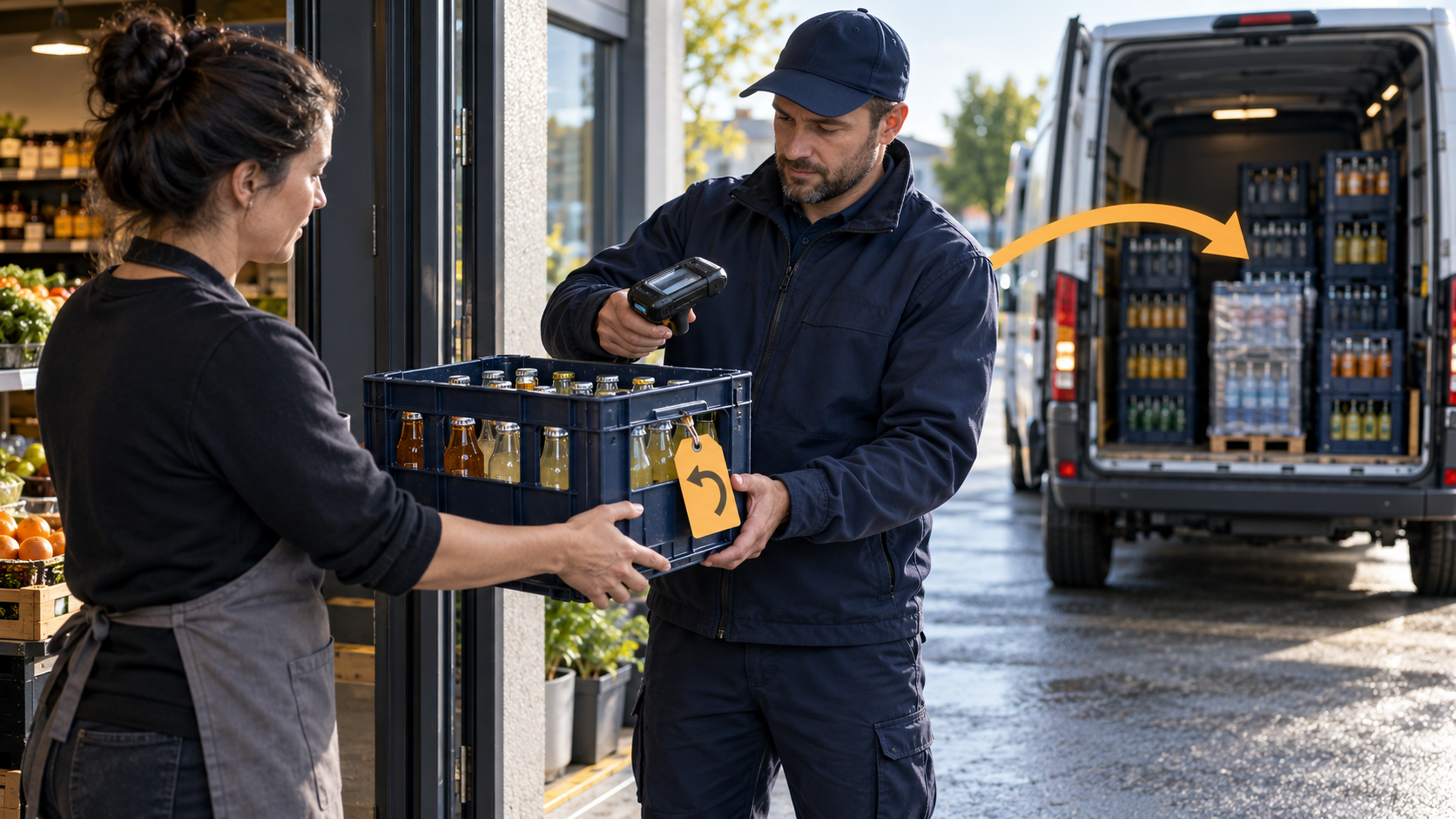
Every field app demo shows the same three steps: deliver, invoice, collect. Nobody demos the return. The refused crate at the door, the recall notice that arrives while the van is already loaded, the credit note the customer expects to be issued on the spot — these are the moments where most field stacks quietly fall over, and where the cost surfaces weeks later as a reconciliation line nobody can explain.
The forward flow gets all the design attention
Field software, ours included, is designed around the forward flow. The data model assumes a clean sequence: order, load, deliver, adjust, invoice, collect, reconcile. That sequence is where the engineering effort goes, because it is where the revenue goes. The reverse flow is treated as an exception path — a return, a recall, a credit — even though in some categories it is a routine part of the working day.
The result is predictable. The forward step has a button. The reverse step has a workaround.
Why reverse flow is structurally harder
It is not that returns are rare. The NRF's 2025 Retail Returns Landscape put total US retail returns at roughly $849.9 billion in 2025, and returns are increasingly treated as an operational function rather than the end of a transaction. The difficulty is structural:
It is one item at a time, in random order. Forward flow moves cases and pallets of the same SKU. Reverse flow handles single units with different reasons and different dispositions.
It needs a decision at the edge. A forward delivery follows a plan. A return requires someone at the door to decide: accept, refuse, replace, credit, or quarantine. That authority has to exist in the app.
It has financial consequence attached. A credit note issued on the spot is money. If it is not linked to the return that caused it, it becomes a finance argument.
Its traceability requirements are heavier. Recalls are not ordinary returns — they involve a specific lot, batch, serial, or expiry, and often a reporting obligation. Pulling the wrong stock is worse than pulling none.
It is a value-recovery problem, not just a cost. Returns, recalls, repairs, repackaging and recycling are all categories where value can be recovered or lost depending on how fast and how accurately the item is processed.
The six-question reverse-flow audit
Use this to test your own stack. Answer yes or no for each; a single "no" is a gap you can price.
# | Question | What a "no" means |
|---|---|---|
1 | Can a driver record a refusal or rejection at the door, with a structured reason, in the same app as the delivery? | Refusals are captured verbally or on paper and lost by end of day |
2 | Can a recall or lot hold be pushed to an active route as a task? | Recalled stock stays on the van until someone remembers |
3 | Is the credit note generated from the return record rather than typed separately? | Two records for one event, and a reconciliation every period |
4 | Does returned stock re-enter inventory with lot, batch, serial or expiry intact? | Traceability breaks at the exact point it is needed most |
5 | Is the return visible in the same system as the forward delivery it reverses? | Reverse activity is invisible to the dashboard that runs the operation |
6 | Can you measure the age of a return — pick-up to credit to final disposition? | You cannot see where recovery is slow or value is leaking |
What breaks, specifically
Three moments account for most of the damage.
The reject at the door. The customer refuses part of the delivery. The driver adjusts the quantity, but the return itself has nowhere to go as structured data, so it becomes a note, a photo, or a call to the depot. By the time it reaches the back office, the reason is gone and the credit is a guess.
The recall mid-route. A batch is flagged after vans are already loaded. If there is no way to push a lot-specific pull task to the route, the recall depends on phone calls and memory — and the recovery ratio depends on luck.
The credit on the spot. The customer expects the credit before the van leaves. If the credit note is a separate document created later, the customer's trust and your ledger both wait on a manual step.
Be honest about your own stack
Most field platforms, ours included, are stronger on the forward flow than the reverse, because that is where the majority of transaction volume and customer value sits. That is a defensible product priority, but it is not a reason to leave the reverse flow undiagnosed. The honest position is: an app is only as complete as its worst routine exception. If returns, recalls, and field credits are routine in your operation, they deserve first-class treatment in the data model, not an exception path bolted on later.
Where a platform does handle the reverse flow well, look for the same things you would demand of the forward flow: offline capture, a structured reason code, a link between the return and the financial document, and traceability carried through to disposition.
What good looks like
A refusal captured at the door with a reason code, on the same record as the delivery.
A recall pushed to the route as an actionable, lot-specific task.
A credit note generated from the return, not alongside it.
Returned stock scanned back into inventory with batch and expiry intact.
One dashboard that shows both directions of the flow.
The fix order
Do not rebuild everything. Start with the event that costs you the most and is easiest to structure: usually the doorstep refusal, because it happens most often. Get that captured as data, linked to the credit, and visible in the same system as the delivery. Then extend the same treatment to recalls — lot-specific, task-based, pushed to the route. The point is not to make the reverse flow as fast as the forward flow. It is to make it as visible, so the cost stops hiding in reconciliation.
Related reading: DSD Digital Transformation: A GMS Checklist for Food Distribution, Mastering Last-Mile Delivery Exceptions, and Why Operational Visibility Is the New Competitive Advantage.