From Proof of Delivery to a 360° View of Field Operations
Every physical business transaction has two realities.
The first is the transaction recorded in the ERP: a purchase order, warehouse receipt, sales order, shipment, invoice, return order, payment, or inventory adjustment.
The second is what actually happened in the warehouse, inside the vehicle, or at the customer location.
Were the expected goods received?
Were the right products loaded onto the correct vehicle?
Did the driver visit the customer?
Were all ordered items delivered?
Who accepted them?
Were any products rejected or returned?
Was payment collected?
Were exceptions documented?
Without reliable electronic evidence from the point of execution, organizations can see the commercial transaction but not the complete operational reality behind it.
Mobile technology closes this gap by capturing structured data, timestamps, locations, scans, photographs, signatures, notes, and payment confirmations directly where work happens. When this information is connected to Microsoft Dynamics 365 Business Central or Finance & Operations, it creates a trustworthy, end-to-end record of warehouse and field operations.
This record supports more than proof of delivery. It becomes a foundation for operational visibility, compliance, auditability, performance improvement, and AI-assisted decision-making.
Two Different Operational Processes
Organizations must distinguish between inbound warehouse processes and outbound customer-facing field processes.
Although both involve inventory and mobile devices, they serve different business purposes.
1. Inbound Procurement and Warehouse Receiving
The inbound process begins with purchasing.
A purchase order is created in Dynamics 365 for goods expected from a supplier. When the shipment reaches a warehouse or distribution center, warehouse workers receive and verify the goods using warehouse mobile devices or applications.
A typical process may include:
Opening the expected purchase order or inbound shipment.
Scanning pallets, cartons, items, serial numbers, or lot numbers.
Comparing received quantities with the purchase order.
Recording shortages, over-deliveries, substitutions, or damaged goods.
Capturing photographs and notes for exceptions.
Posting the warehouse receipt or product receipt.
Directing the goods to staging, quality control, cross-docking, or put-away.
Confirming the final warehouse bin or storage location.
The principal operational roles are warehouse receivers, forklift operators, quality-control personnel, and warehouse supervisors.
The main business documents are purchase orders, inbound shipment records, warehouse receipts, product receipts, and put-away instructions.
The purpose of electronic evidence in this process is to prove what the organization received from its supplier and how the inventory entered the warehouse.
This supports:
supplier claims and dispute resolution;
inventory accuracy;
traceability of batches and serial numbers;
quality-control procedures;
warehouse productivity measurement;
purchasing reconciliation;
financial audit;
regulatory compliance.
This process should not be described as DSD, van sales, or proof of delivery to a customer. It is an inbound procurement and warehouse operation.
2. Outbound Sales, Delivery, DSD, and Customer Service
The outbound process begins with a customer requirement.
Depending on the business model, this may be represented by a sales order, delivery route, scheduled visit, invoice, service request, or a van-sales opportunity.
The work is performed by a salesperson, driver, merchandiser, delivery representative, or field service employee using a mobile application.
A typical customer visit may include:
Starting the assigned route or journey.
Navigating to the customer location.
Confirming arrival through a timestamp and, where appropriate, GPS.
Reviewing the customer, order, delivery, invoice, and account information.
Scanning or confirming the goods delivered.
Recording shortages, substitutions, rejected products, or partial delivery.
Capturing the recipient’s name and signature.
Taking photographs of the delivery, documents, assets, shelves, or exceptions.
Processing returns, damaged goods, reusable packaging, or unsold stock.
Creating an invoice, credit note, or return transaction.
Collecting and recording payment.
Completing surveys, inspections, merchandising, or service tasks.
Closing the visit and synchronizing the result with Dynamics 365.
The principal operational roles are sales representatives, van-sales representatives, delivery drivers, DSD personnel, merchandisers, field service technicians, and supervisors.
The main business documents include sales orders, transfer orders, shipments, invoices, return orders, credit notes, payment records, visit records, and service documents.
The purpose of electronic evidence in this process is to demonstrate what happened between the organization and the customer at the point of service.
Proof of Delivery Is More Than a Signature
Proof of delivery is often reduced to a single digital signature. A signature is useful, but by itself it provides only limited context.
A complete electronic proof-of-delivery record can contain:
customer and delivery location;
sales order, shipment, or invoice reference;
route and visit reference;
assigned salesperson or driver;
assigned vehicle;
arrival and completion timestamps;
GPS coordinates, where appropriate and permitted;
delivered items and quantities;
scanned item, lot, serial, or package identifiers;
shortages and rejected quantities;
substitutions;
returned products;
return reasons;
photographs;
recipient name and role;
digital signature;
payment method and amount collected;
notes and exception codes;
document print or email confirmation;
device and synchronization information.
Together, these elements create a much stronger account of the transaction than a signed image attached to an invoice.
They answer not only whether the customer signed, but also:
what was delivered;
what was not delivered;
when and where the transaction occurred;
who performed it;
who accepted it;
which exceptions occurred;
how inventory changed;
whether payment was collected;
which follow-up actions are required.
Electronic Evidence Across the Complete Field Visit
Delivery is frequently only one part of a broader customer visit.
A salesperson or driver may also:
inspect the customer’s inventory;
check product availability;
capture shelf photographs;
record competitor information;
take a new order;
collect empty containers or reusable packaging;
process expired or damaged products;
collect outstanding invoices;
perform a survey;
inspect a company-owned asset;
report a service issue;
obtain approval for an exception;
recommend the next visit or action.
A well-designed mobile workflow connects these activities to the same customer, route, visit, document, employee, and vehicle context.
This creates a complete electronic visit record rather than several disconnected transactions.
For example, the system should be able to show that:
a driver arrived at the customer at 10:12;
three invoices were scheduled for delivery;
two were delivered completely;
one had a shortage of four units;
the customer returned six damaged products;
the driver collected an outstanding payment;
a photograph documented a damaged display refrigerator;
the customer signed at 10:38;
the vehicle inventory and customer balance were updated;
a service request was automatically created for the damaged asset.
This is the practical meaning of a 360° view of field execution.
Connecting Warehouse and Field Operations Without Mixing Them
Inbound warehouse receiving and outbound field execution are separate processes, but they belong to the same operational chain.
Goods may move through the following sequence:
Products are purchased from a supplier.
Warehouse workers receive them against a purchase order.
The products are inspected and placed into warehouse inventory.
Stock is picked and loaded onto a vehicle.
The vehicle begins a delivery or van-sales journey.
Products are delivered or sold to customers.
Returns and reusable packaging are collected.
Payments and customer acknowledgements are recorded.
Remaining vehicle inventory is reconciled.
Returned stock is received back into the warehouse.
All resulting inventory and financial transactions are posted to Dynamics 365.
Each stage has its own documents, responsibilities, controls, and evidence.
The technology should connect these stages while preserving their business meaning.
For example:
supplier receipt evidence should be linked to the purchase order;
vehicle loading evidence should be linked to a transfer, load, or route;
delivery evidence should be linked to the sales order, shipment, or invoice;
customer return evidence should be linked to a return order or credit process;
payment evidence should be linked to the relevant customer and financial document;
end-of-day reconciliation should be linked to the vehicle, agent, route, and inventory movements.
Building a Reliable Operational Record
Electronic evidence becomes valuable only when it is structured and connected to the relevant business transaction.
A photograph saved in a phone gallery is not an operational record.
A signature stored without the related customer, order, employee, time, and delivered quantities provides limited value.
A trustworthy operational record should be:
Transaction-aware
Every piece of evidence should be associated with the correct business document or operational object, such as a purchase order, sales order, shipment, invoice, return, payment, visit, route, asset, or service request.
Process-aware
The application should understand whether the user is receiving supplier goods, loading a vehicle, delivering a sales order, making a van sale, collecting a return, or receiving returned stock at the warehouse.
The same generic “receive” action should not be used for fundamentally different processes.
Role-aware
Warehouse workers, drivers, salespeople, service technicians, and supervisors require different workflows, permissions, information, and controls.
Time-aware
The system should retain when each meaningful event occurred, not only when the final transaction was synchronized.
Location-aware
Where appropriate, the record can include the warehouse, bin, vehicle, customer location, service site, or geographic coordinates.
Exception-aware
Shortages, damages, customer refusals, payment differences, failed visits, unauthorized substitutions, and other deviations should be captured as structured exceptions rather than free-text comments alone.
Audit-ready
The system should preserve who performed an action, what was changed, when it occurred, and which evidence supports it.
Operational Visibility for Managers
Once warehouse and field evidence is captured consistently, managers gain visibility that cannot be produced from invoices alone.
They can monitor:
purchase-order receiving accuracy;
supplier shortages and damage frequency;
warehouse receiving and put-away time;
vehicle loading accuracy;
route start and completion time;
on-time arrival and delivery;
complete versus partial deliveries;
rejected and returned quantities;
reasons for unsuccessful visits;
payment-collection performance;
inventory differences by vehicle or employee;
customer service execution;
proof-of-delivery completeness;
compliance with required visit steps;
unresolved exceptions;
recurring operational bottlenecks.
This allows management to move from assumptions and retrospective explanations to evidence-based operational control.
Compliance and Audit
Many organizations define procedures but cannot prove consistently that those procedures were followed.
A policy may require that:
every delivery is signed;
photographs are taken for damaged products;
returns include a reason code;
cash collection is acknowledged;
vehicle inventory is counted at journey end;
high-value discrepancies require supervisor approval;
customer assets are inspected during scheduled visits.
A process-aware mobile application can enforce these requirements at the appropriate stage.
It can prevent a delivery from being completed without mandatory evidence, request approval for an exception, or automatically create a follow-up action.
The resulting records support:
internal control;
customer dispute resolution;
financial audit;
health and safety procedures;
product traceability;
regulated distribution;
contractual compliance;
insurance and claims processing.
From Reporting to Continuous Improvement
Operational evidence is not only for proving that an event occurred. It can reveal how the operation performs and where it should improve.
Organizations can analyze questions such as:
Which suppliers create the most receiving discrepancies?
Which warehouse shifts experience the longest receiving times?
Which routes produce repeated shortages?
Which customers frequently reject the same products?
Which drivers have unusually high inventory differences?
Which visits take longer than expected, and why?
Which products generate the most returns?
Which process steps are commonly skipped?
Which exceptions result in repeat visits or credit notes?
Where are employees spending time without producing a business outcome?
Because the information is linked to transactions, customers, employees, vehicles, routes, locations, and timestamps, it becomes suitable for dashboards, operational reviews, root-cause analysis, and process redesign.
Preparing Field Operations for AI
Structured electronic evidence also creates the data foundation required for meaningful AI use.
AI cannot reliably improve a field operation when it sees only invoices and aggregated sales figures. It needs process context.
It needs to understand:
what was planned;
what was executed;
what evidence was captured;
which exceptions occurred;
which rules applied;
what the commercial and inventory outcome was;
what happened in similar situations previously.
This information can support AI agents that:
summarize daily field activity;
identify unusual deliveries or returns;
detect repeated compliance failures;
explain differences between planned and actual execution;
prioritize unresolved exceptions;
recommend coaching for employees;
suggest improvements to routes and visit plans;
identify customers at risk;
prepare operational reports;
recommend the next best action;
initiate governed follow-up workflows.
For example, a Dynamics Mobile Field Operations Agent could review the complete operational record and report:
Route 18 completed 21 of 23 planned visits. Two visits failed because the customers were closed. Three deliveries contained shortages, all involving the same product loaded from the same warehouse batch. One high-value return lacks the required photograph. The driver collected 94% of scheduled payments. Recommended actions: investigate the warehouse batch, request evidence for the return, and reschedule the two failed visits.
This is substantially more useful than a generic AI summary of sales totals.
The objective is not to add AI to an incomplete process. The objective is to create governed, process-aware, AI-consumable operations.
The Role of Dynamics Mobile and Dynamics 365
Dynamics 365 Business Central or Finance & Operations remains the transactional and financial system of record.
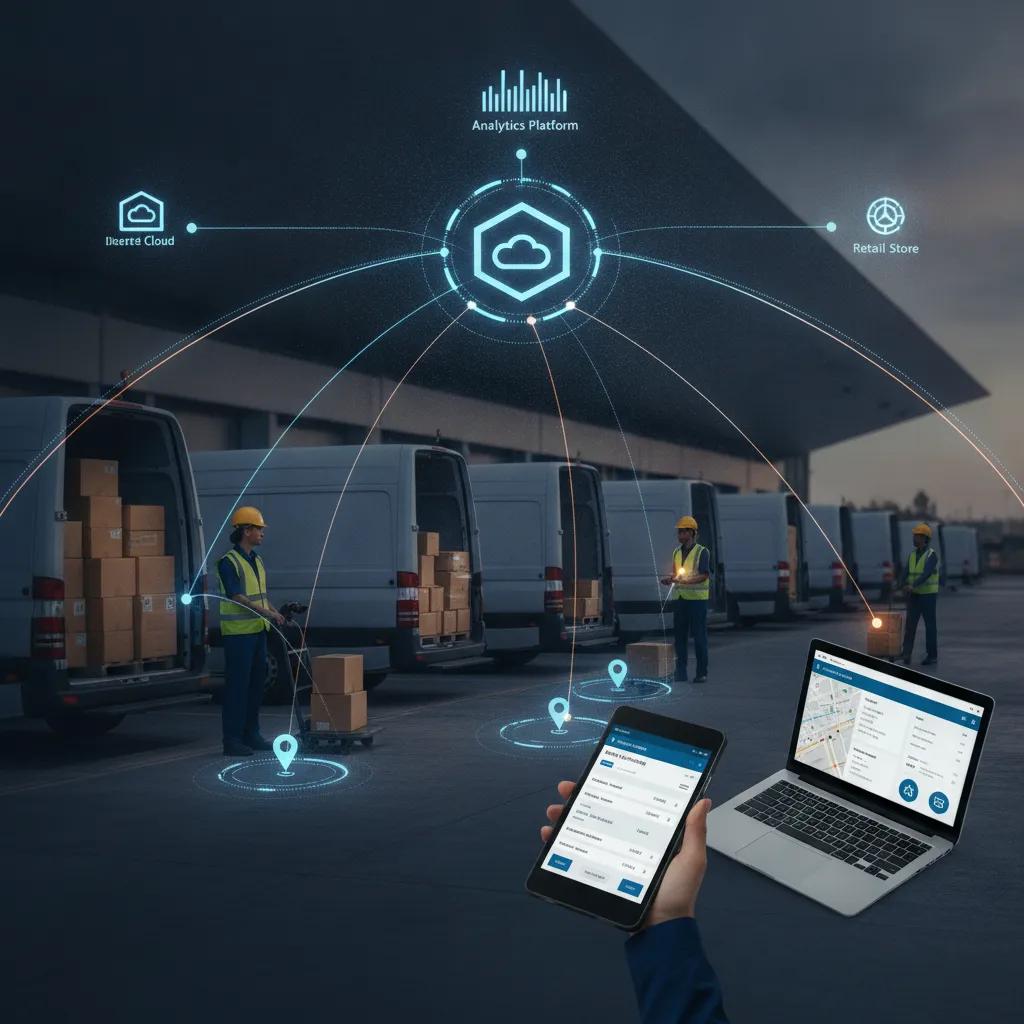
Dynamics Mobile extends that system into the places where physical work occurs:
receiving docks;
warehouse aisles;
loading areas;
delivery vehicles;
retail stores;
customer premises;
service locations.
The mobile application guides employees through the relevant business process, captures electronic evidence, supports online and offline work, and synchronizes the operational result with Dynamics 365.
This creates a connected environment in which:
warehouse transactions reflect physical inventory movements;
sales and delivery documents reflect actual customer execution;
returns and payments are recorded at their source;
managers can see operational progress and exceptions;
auditors can trace transactions to supporting evidence;
analytics can identify patterns and improvement opportunities;
AI agents can reason over structured, governed field data.
Conclusion
Proof of delivery should not be treated as an isolated signature-capture feature.
It is one component of a broader operational-evidence system connecting warehouse activities, vehicle inventory, customer visits, deliveries, sales, returns, payments, and service execution.
The key is to preserve the meaning of each business process:
purchase orders and warehouse receipts belong to inbound procurement and warehouse operations;
sales orders, shipments, invoices, returns, and payments belong to outbound customer and field operations;
loading, vehicle inventory, and reconciliation connect the warehouse to the route;
electronic evidence connects physical execution to the ERP record.
When these processes are digitized correctly, organizations gain more than faster data entry. They gain an accurate and auditable view of what is happening across their physical operations.
That 360° view can then be used for reporting, compliance, performance management, continuous improvement, and a new generation of governed AI-powered field operations.